
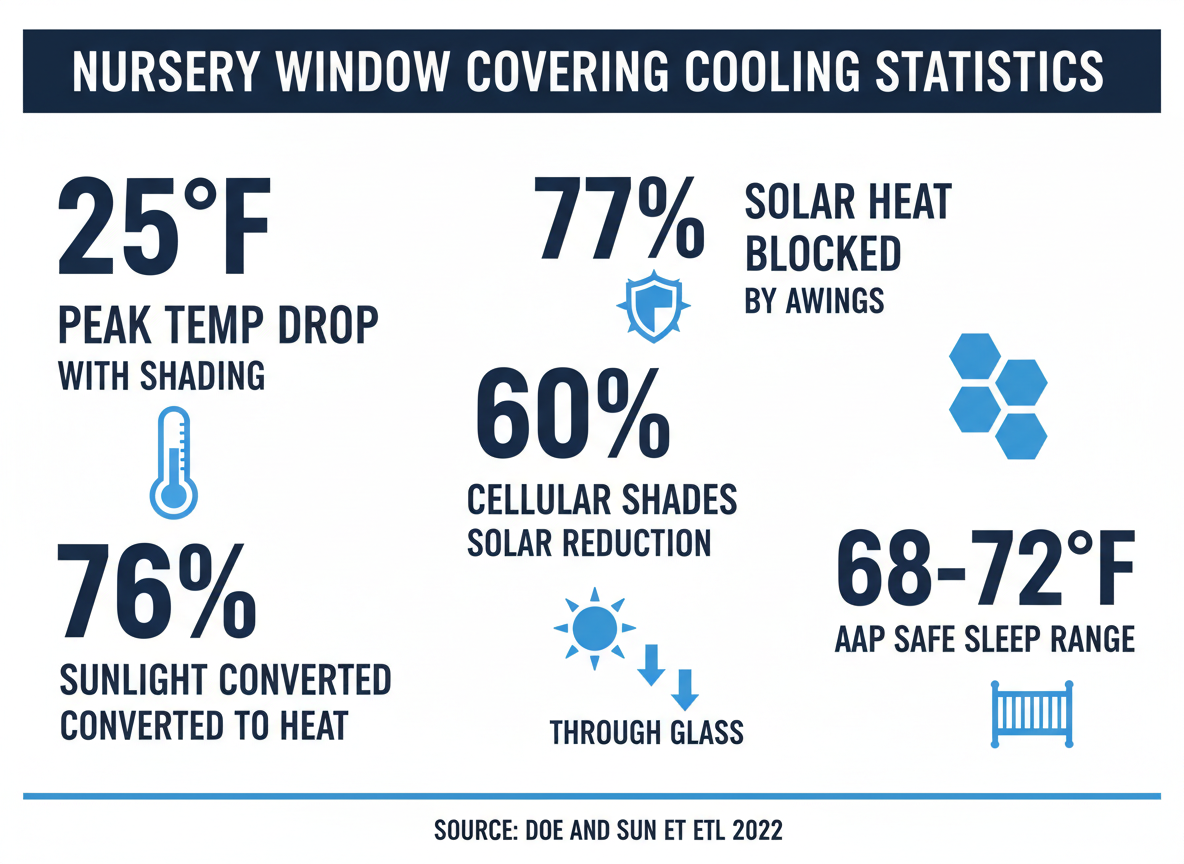
Peak indoor temperature reduction achievable with integrated exterior shading plus natural ventilation during an extreme heat event - measured in real Pacific Northwest homes without air conditioning.
Source: Sun et al. 2022, Applied Energy (June 2021 Portland heat dome field study) - cross-verified by PNNL and DOE Building America resources
Key Takeaways
- 77% - Solar heat reduction from west-facing window awnings, the highest of any single intervention. (DOE Energy Saver, 2024)
- Up to 60% - Solar heat gain reduction from interior cellular (honeycomb) shades, the best renter-friendly option. (DOE Energy Saver + PNNL-24857)
- 76% - Of sunlight striking standard double-pane glass converts to indoor heat during the cooling season. (DOE Energy Saver, 2024)
- 68-72°F - AAP/CDC recommended nursery temperature for safe infant sleep; overheating raises SIDS risk. (AAP 2022, CDC)
- 2x - More summer solar heat per square foot through west-facing windows compared to south-facing, at continental U.S. latitudes. (BASC/PNNL, 2024)
- 10.4% - Cooling HVAC savings from cellular shades vs. vinyl blinds in PNNL's controlled Lab Homes test - rising to 25% in optimized deployment. (PNNL-24857, Cort et al.)
- 55% - Reduction in dangerous heat-index hours during the 2021 heat dome from exterior shading alone. (BASC PNNL citing Rempel et al. 2022)
- 46% vs 14% - The same solar screen fabric delivers 46% heat reduction on the exterior but only 14% on the interior - location is everything. (BASC PNNL / Brunger et al. 1999)
Why West-Facing Windows Are the Hardest Problem
West-facing windows are the worst orientation for summer heat - not south-facing, despite what most people assume. At continental U.S. latitudes, east- and west-facing windows receive as much as twice the solar heat per square foot as south-facing windows during summer months, according to PNNL's Building America Solution Center. The reason is geometry: a low afternoon sun drives radiation almost horizontally through a west window at the exact moment outdoor temperatures peak - typically 3 p.m. to 6 p.m. South-facing windows receive their peak at midday, when the sun is high and its path through the glass is shorter.
That timing is what makes a west-facing nursery window so disruptive. The afternoon sun hits precisely during infant nap time, in the hottest hours of the day, with no overnight recovery until the room cools after sunset. Parents on Reddit describe the effect consistently: one r/beyondthebump commenter reported their nursery ran 10°F above the rest of the house during afternoon hours - a gap confirmed as directionally accurate by GreenBuildingAdvisor's heat gain modeling (indoor temps of 76-79°F when AC holds the rest of the home at 72°F).
And the underlying physics is severe. About 76% of sunlight striking standard double-pane glass enters the home as heat during the cooling season (DOE Energy Saver). Windows account for 20-30% of a home's entire cooling load in hot climates. A single unshaded west-facing nursery window can generate enough solar heat gain to overwhelm the room's air exchange - which is why covering it is the highest-leverage single action available to parents.
| Metric | Value | Source |
|---|---|---|
| Solar heat per sq ft, west-facing vs. south-facing (summer) | 2x more | BASC/PNNL, 2024 |
| Peak heat gain timing, west windows | 3-6 p.m. | GreenBuildingAdvisor, 2024 |
| Peak heat gain timing, south windows | Midday | GreenBuildingAdvisor, 2024 |
| Sunlight through standard double-pane glass that becomes heat | 76% | DOE Energy Saver, 2024 |
| Windows' share of residential cooling load (hot climates) | 20-30% | DOE Energy Saver, 2024 |
| West/east window premium on cooling costs (warm regions) | 15-25% | AWP Windows, 2024 |
For parents choosing between a cellular shade and a standard roller blind, understanding this geometry is essential. Reducing 76% of incoming solar radiation that would otherwise become trapped heat requires an intervention that's both in place and effective before 3 p.m. - which is why the main buying guide hub prioritizes solar heat gain reduction as the first filter for west and south-facing rooms.
The 68-72°F Target: What the Data Means for Your Nursery
The American Academy of Pediatrics 2022 Safe Sleep Policy Statement and CDC guidelines recommend keeping an infant's sleep room at 68-72°F (20-22°C). Overheating makes it harder for infants to arouse from sleep - a mechanism associated with increased SIDS risk. The AAP's 2022 policy explicitly identifies overheating as a modifiable risk factor, and HealthyChildren.org and the NICHD's Safe to Sleep program both cite the 68-72°F range as the clinically practical target.
The nuance worth stating clearly: the AAP acknowledges that research studies define "overheating" differently, and the policy statement does not set 72°F as a hard regulatory threshold. The 68-72°F range is the clinical recommendation used by pediatricians - not a mandated temperature with a bright line above which SIDS probability jumps. But that nuance doesn't blunt the practical implication: a west-facing nursery that runs 10°F above baseline in the afternoon can easily reach 82-85°F when the rest of the house is at 72°F. That's 10-13°F above the top of the safe-sleep range.
| Benchmark | Value | Source |
|---|---|---|
| AAP/CDC recommended nursery sleep temperature | 68-72°F | AAP 2022 / CDC Safe to Sleep |
| Reported nursery premium above rest of house (west-facing, unshaded) | +10°F | r/beyondthebump, 2023 (user-reported) |
| Potential nursery temp if baseline is 72°F and unshaded | ~82°F | Extrapolated from field reports + DOE data |
| Gap above top of AAP-recommended range at 82°F | 10°F above target | Calculated |
This is the clinical anchoring point for everything that follows. Every percentage of solar heat gain reduction in the intervention table below translates directly into degrees Fahrenheit - and the question of whether a nursery stays in the 68-72°F safe window depends on which intervention a parent chooses and whether they deploy it consistently. Our nursery blackout blinds guide addresses the light-blocking dimension of this same problem - but this article focuses specifically on the thermal management question backed by measured data.
The Core Data: Ranked Intervention Table by Solar Heat Reduction
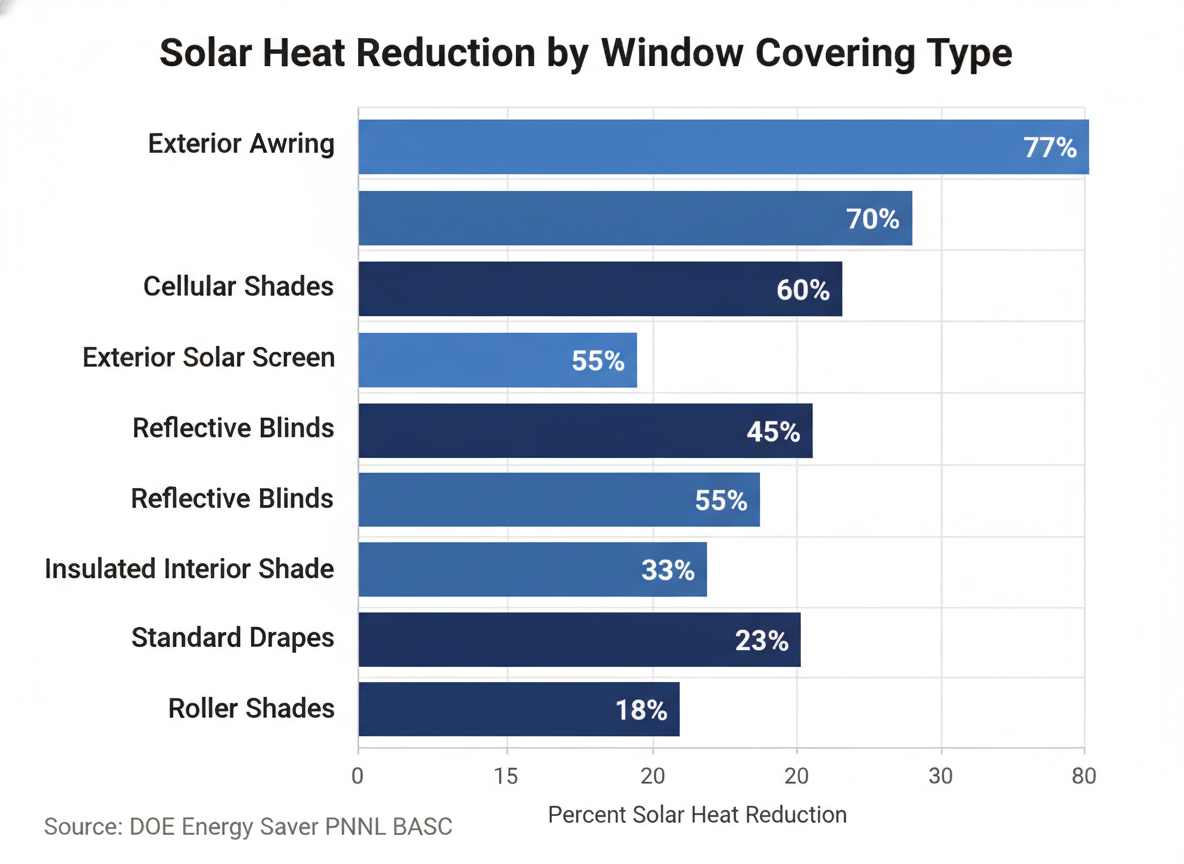
The table below ranks nine interventions by their measured or DOE/PNNL-reported percentage reduction in solar heat gain on west-facing windows. The estimated °F drop is calculated from the 10°F baseline differential reported in real west-facing nursery scenarios - treat these as directional estimates, not measured product figures. Only the 25°F hero stat above is a directly measured combined-intervention result; individual °F estimates here are derived from applying DOE/PNNL percentage reductions to the 10°F baseline gap.
| # | Intervention | Solar Heat Reduction | Est. °F Drop* | Renter-Friendly | Approx. Cost / Window |
|---|---|---|---|---|---|
| 1 | Exterior awning (west-facing) | Up to 77% | ~7-8°F | No | $200-$6,000 |
| 2 | Spectrally selective window film (high-perf ceramic) | 60-78% TSER | ~6-8°F | Ask landlord | $7-$24/sq ft (pro) |
| 3 | Interior cellular (honeycomb) shade | Up to 60% | ~6°F | Yes | $55-$380 |
| 4 | Exterior solar screen | Up to 46% | ~4-5°F | Check lease | $50-$150 |
| 5 | Reflective interior blinds (closed) | ~45% | ~4-5°F | Yes | $20-$80 |
| 6 | Draperies with white-plastic backing | ~33% | ~3°F | Yes | $30-$150 |
| 7 | Interior insulating shade (non-cellular) | ~23% | ~2°F | Yes | $30-$120 |
| 8 | Interior roller shade | ~18% | ~2°F | Yes | $25-$150 |
| 9 | Interior insect/solar screen (fabric) | ~14% | ~1°F | Yes | $15-$60 |
*°F estimates are directional, derived from applying DOE/PNNL reduction percentages to a 10°F baseline differential. Sources: DOE Energy Saver (2024), BASC/PNNL, PNNL-24857, Angi 2026, Fixr 2026.
The gap between rank 1 (exterior awning, 77%) and rank 3 (cellular shade, 60%) is smaller than most parents expect - about 17 percentage points - while the gap between rank 3 and rank 9 (interior screen, 14%) is enormous: 46 points. For renters, the practical decision is between cellular shades and window film; both outperform reflective blinds and standard roller shades by a wide margin. If your lease permits exterior modifications, a $50-$150 exterior solar screen delivers performance close to an awning for a fraction of the cost - though you'll want to check whether "no permanent modifications" clauses apply.
Parents who are weighing interior options specifically should read our comparison of cellular vs. roller shades - the thermal performance difference is meaningful, but there are installation and light-control tradeoffs worth understanding before purchase.
Exterior vs. Interior Placement: The 3x Effectiveness Gap
The single most important piece of building science for a nursery parent to understand is this: the same product performs radically differently depending on whether it's mounted outside or inside the window. PNNL researchers measured this directly using solar screen fabric. Installed on the exterior, it reduced solar heat gain through windows by 46%. Installed on the interior, the identical fabric reduced it by only 14% - a 3.3x performance gap from nothing but location (Brunger et al. 1999, cited by BASC PNNL).
The physics explains why: exterior placement intercepts solar radiation before it crosses the glass and converts to trapped heat inside the thermal envelope. Interior placement - no matter how reflective - is working after the radiation has already entered the space. Some heat escapes back out through the glass, but much of it is trapped between the shade and the glass surface, which heats up and radiates inward. This is why a parent putting up blackout curtains over a west-facing nursery window may see less cooling benefit than expected: the curtain reflects some light but the heat it intercepts has already entered the room.
| Placement | Solar Heat Reduction | Source |
|---|---|---|
| Exterior solar screen / insect screen | 46% | BASC PNNL (Brunger et al. 1999) |
| Interior solar screen (same fabric) | 14% | BASC PNNL (Brunger et al. 1999) |
| Exterior awning, west-facing | Up to 77% | DOE Energy Saver, 2024 |
| Interior cellular shade | Up to 60% | DOE Energy Saver / PNNL-24857 |
| Exterior reduction in dangerous heat-index hours (2021 heat dome) | 55% | BASC PNNL (Rempel et al. 2022) |
| Interior insulating shade, dangerous heat-index hours | 23% | BASC PNNL (Rempel et al. 2022) |
| Interior roller shade, dangerous heat-index hours | 18% | BASC PNNL (Rempel et al. 2022) |
LBNL's residential windows simulation - run across 16,486 building-climate combinations - confirms the pattern: in cooling-dominated climates, all window attachments save energy, but exterior attachments always deliver the greatest absolute savings. If your lease permits exterior screens (many do, since they're removable), a $50-$150 fixed solar screen gives you more than three times the cooling performance of interior alternatives at a similar price point. For options that work without exterior mounting, cellular shades are the clear leader among interior products - their dual-cell honeycomb structure traps air and adds meaningful insulation value that a standard roller or reflective blind lacks. Our guide to renter-friendly no-drill blinds covers the tension-mount and outside-mount installation methods that make cellular shades removable.
Cellular Shades: The Renter's Highest-Performing Interior Option
Cellular (honeycomb) shades block up to 60% of solar heat gain - nearly matching the exterior solar screen - while being fully renter-friendly when installed with a tension mount. PNNL's Lab Homes study (PNNL-24857, Cort et al.) is the most rigorous field test of cellular shade performance: side-by-side controlled homes in Richland, WA, measured cellular shades against standard vinyl blinds over a full cooling season.
| Metric | Value | Source |
|---|---|---|
| Cooling HVAC savings, cellular vs. vinyl blinds (baseline) | 10.4% +/-6.5% | PNNL-24857, Cort et al. 2016 |
| Cooling HVAC savings, optimized deployment (all high-gain windows covered) | Up to 25% | DOE BTO Fact Sheet, 2021 |
| Savings when west/south windows left uncovered | ~5% | PNNL-24857, Cort et al. 2016 |
| Savings, "Green" optimized schedule (motorized/scheduled) | 15% summer | PNNL-27663, Cort et al. 2018 |
| Solar heat gain reduction (interior cellular shade) | Up to 60% | DOE Energy Saver, 2024 |
| Cost per window (manual, installed) | $55-$380 | Fixr / Angi, 2025-2026 |
| Cost per window (motorized) | $160-$520+ | Fixr / Angi, 2025-2026 |
The behavioral implication of the 5% finding is the most actionable data point in this entire article: it doesn't matter how well you shade every other window in the house if you leave the west-facing nursery window uncovered. The west window is the dominant solar gain source in the afternoon, and covering it first is the right sequence. A $60 cellular shade on the nursery's west window will do more for afternoon temperatures than $500 in shades spread across north- and east-facing windows.
Cordless cellular shades also address the child safety dimension of the problem. The AAP, CPSC, and industry groups have all moved toward cordless designs for child-accessible windows. Our guide to child-safe cordless blinds covers the specific cordless cellular options available for inside-mount tension installation - relevant for any nursery parent who also needs a no-drill solution.
For parents comparing cellular to roller shades on a budget, the performance gap is clear: cellular shades block up to 60% of solar heat gain, while interior roller shades block approximately 18% in PNNL's heat-index-hour measurement. That's a 42-percentage-point difference for a product that often costs within the same price range. If thermal performance is the priority, the comparison between these product types consistently resolves in favor of cellular - though our blackout vs. room darkening guide covers the light-blocking tradeoffs that sometimes push parents toward roller or panel designs.
Window Film: The Renter-Friendly Permanent Upgrade
Spectrally selective window films filter 40-70% of solar heat transmitted through glass (DOE Energy Saver / FSEC). High-performance ceramic films - 3M Prestige, Llumar IRX - achieve 60-78% Total Solar Energy Rejection (TSER), which means their best-case performance approaches the exterior awning on the heat-blocking metric. DIY adhesive films (Gila Heat Control, Solar Gard) achieve lower TSER in the 40-57% range and are installed without professional help.
| Film Type | TSER Range | Source |
|---|---|---|
| High-performance ceramic film (3M Prestige, Llumar IRX) | 60-78% | DOE Energy Saver / FSEC, 2024 |
| DIY adhesive film (Gila, Solar Gard) | 40-57% | DOE Energy Saver / FSEC, 2024 |
| Static-cling film (fully removable) | ~40-55% | DOE / FSEC range |
| Cost, professional installation | $7-$24/sq ft | Concord Window Film / windowfilm.com, 2025 |
| Cost, DIY adhesive film | $1-$5/sq ft | Concord Window Film / windowfilm.com, 2025 |
Film's key advantage for renters: static-cling variants leave zero residue, making them fully removable and compliant with virtually any lease. One r/beyondthebump parent reported a 5°F+ drop on a south-facing bedroom window from Gila Heat Control film - directionally consistent with the DOE/FSEC data, though user-reported and not scientifically measured. The critical limitation: adhesive films are semi-permanent and require landlord permission; professional ceramic films require professional installation and are not removable. If you're renting and want to layer solutions, static-cling film plus a cordless cellular shade is the highest-performing renter combination with no lease risk.
One important distinction to flag: some film manufacturers advertise "up to 97% infrared rejection." That figure refers specifically to infrared radiation, which is only a portion of the solar spectrum. TSER is the meaningful metric for cooling - it measures heat rejection across all wavelengths. A film with 97% IR rejection may have a TSER of only 55-65%, which is still excellent but not the same number. The DOE and FSEC consistently use TSER as the standard. When evaluating film products for a nursery, filter by TSER - not IR-only claims.
For the specific question of which mount type works best when adding film or a shade to a nursery window, our guide on inside mount vs. outside mount covers the measurement and light-gap tradeoffs that affect both heat blocking and room-darkening performance.
Nursery Temperature Estimator
Enter your nursery's current afternoon temperature and select an intervention to estimate your cooled temperature. These estimates are based on DOE/PNNL solar heat gain reduction percentages applied to the temperature difference between your room and the rest of your home. They are directional - not a replacement for a thermometer. Individual results depend on window size, home construction, ventilation, and consistent deployment of the covering.
Nursery Temperature Estimator
Based on DOE/PNNL solar heat gain reduction data. Estimates are directional.
The 75% Problem: Why Automation Matters
DOE Energy Saver cites a behavioral survey of 2,100 households finding that 75% of residential window coverings remain in the same position all day. Even a cellular shade that blocks 60% of solar heat gain delivers minimal benefit if it's raised when afternoon sun hits the west window. This behavioral reality is the hidden variable that explains why parents sometimes install good window coverings and still have an overheated nursery.
| Metric | Value | Source |
|---|---|---|
| Residential window coverings not moved daily | 75% | DOE Energy Saver (behavioral survey, 2,100 households) |
| HVAC savings with optimized "Green" schedule (motorized/timed) | 15% summer | PNNL-27663, Cort et al. 2018 |
| Whole-home cooling savings, optimized window attachment deployment | 15-25% | BASC PNNL (Cort 2018 / Hunt 2020) |
| Passive shading + ventilation: thermal relief hours during 10-day heat event | 130-150 hours | Sun et al. 2022 (Applied Energy) |
The practical solution is automation or a consistent routine. PNNL's 2018 study (PNNL-27663) tested motorized cellular shades on a "Green" schedule - automatically closing before afternoon sun exposure - and achieved 15% summer HVAC savings versus vinyl blinds operated identically, versus 10.4% for the non-scheduled manual condition. For nursery parents, motorized shades ($160-$520 per window) payback via energy savings and reduced HVAC wear, but the more compelling value is removing the behavioral failure mode entirely: the shade closes itself at 12:30 p.m. whether you remember or not.
If motorized isn't in budget, a phone alarm set for 1 p.m. ("close nursery shade") is the free equivalent. The energy savings aren't the primary motivator for most parents - the temperature is. And the data is clear: a shade that's consistently closed before 3 p.m. is worth far more than an expensive shade that's usually left open. Our guide to energy-saving blinds covers the whole-home deployment strategy in more detail, including which windows to prioritize when you're choosing where to invest first.
Frequently Asked Questions
What temperature should a nursery be for safe infant sleep?
The AAP and CDC recommend keeping the infant sleep room at 68-72°F (20-22°C). Overheating raises the risk of SIDS by making it harder for infants to arouse from sleep. On a hot afternoon, a west-facing nursery can easily run 10°F above the rest of the house if the window is unshaded - potentially reaching 82-85°F when the AAP target is 68-72°F. The 68-72°F range is a clinical recommendation, not a hard regulatory threshold, but the pediatric consensus on overheating as a modifiable SIDS risk factor is strong.
What window covering blocks the most heat in a nursery?
For sheer percentage of solar heat blocked, exterior awnings top the list at up to 77% reduction on west-facing windows (DOE Energy Saver). For renters or those who cannot install exterior fixtures, dual-cell cellular shades are the best interior option - blocking up to 60% of solar heat gain and providing the highest R-value of any interior window covering. High-performance ceramic window film (60-78% TSER) matches or exceeds cellular shades on the heat metric and can be applied without hardware. Layering a cellular shade with blackout curtains over it provides the best renter-friendly combination, though you lose some ventilation control.
Does window film actually cool a room?
Yes - spectrally selective window films filter 40-70% of solar heat transmitted through glass (DOE / FSEC). High-performance ceramic films (3M Prestige, Llumar IRX) achieve 60-78% Total Solar Energy Rejection (TSER). One Reddit parent reported a 5°F+ drop on a sun-facing bedroom window from Gila Heat Control film (user-reported, not independently measured). The key: evaluate films by TSER, not by manufacturer "infrared rejection" claims, which measure only one portion of the solar spectrum and overstate real-world cooling performance. Static-cling versions are fully renter-friendly and leave no residue.
What's the difference between exterior solar screens and interior solar shades?
Location is everything. The same solar screen fabric installed on the exterior reduces solar heat gain by 46%; installed on the interior it reduces it by only 14% - a 3.3x gap (PNNL / Brunger et al. 1999). Exterior placement intercepts solar radiation before it crosses the glass and converts to trapped indoor heat. Interior shades - even cellular shades at 60% - are working after radiation has already entered the thermal envelope. If your lease permits exterior screens (many do, since they're removable), the exterior placement premium is worth $50-$150 per window. Our bedroom blinds guide covers placement tradeoffs in depth for light- and heat-sensitive rooms.
Are cellular shades worth it for a nursery?
Yes, particularly for renters. In PNNL's controlled field tests, cellular shades cut whole-home cooling HVAC use by 10.4% (+/-6.5%) vs. vinyl blinds - rising to 25% in best-case optimized deployment. The critical behavioral finding: savings drop to approximately 5% when west- and south-facing windows are left uncovered. For a nursery with one west window, consistently closing the cellular shade before 1 p.m. captures most of that benefit. Cordless cellular shades also meet child-safety recommendations for windows in child-accessible rooms. Cost: $55-$380 per window installed (manual).
Can shading a nursery window really make a 25-degree difference?
That figure comes from a peer-reviewed Applied Energy study (Sun et al. 2022) of the 2021 Pacific Northwest heat dome: integrated exterior shading plus night ventilation cut peak indoor air temperature by approximately 14°C (25°F) in Portland homes without air conditioning. It's an important qualifier: this was exterior shading combined with ventilation, not a single window covering. In a typical nursery scenario - shading one west window with a cellular shade or exterior screen during peak hours - parents can realistically expect 5-15°F of relief, depending on window size, home construction, and whether ventilation is added.
I'm renting - what's the best heat-blocking window covering for my baby's room?
Three renter-friendly options ranked by heat reduction: (1) Interior cellular/honeycomb shade: up to 60% solar heat reduction, $55-$380 per window, installable with a tension mount - no drilling required; (2) Static-cling spectrally selective window film: 40-57% TSER, $1-$5/sq ft DIY, fully removable; (3) Interior solar shade (3-5% openness factor): similar to exterior solar screen performance but inside the frame. For the nursery west window specifically, a cellular shade plus blackout curtain layered over it is the highest-performing renter combination. Our interactive which blinds quiz can help narrow down the right product type for your specific situation.
Why is a west-facing nursery window hotter than south-facing windows?
During summer, east- and west-facing windows receive as much as twice the solar heat per square foot as south-facing windows at continental U.S. latitudes (BASC/PNNL). The reason is sun angle: the low afternoon sun sends radiation almost horizontally through a west window at peak outdoor temperature - typically 3-6 p.m. South-facing windows receive peak radiation at midday when the sun is high and its path through the glass is shorter, and outdoor temperatures are still building. A west window is simply in the wrong place at the hottest time of day - and that timing coincides precisely with infant afternoon nap time.
Methodology
Research date: April 23, 2026. Sources consulted: 66 URLs across Reddit, government/national lab sources, academic publications, cost aggregators, and industry blogs. Sources cited in fact sheet: 19 primary and secondary sources.
Data verification: Every fact in this article maps to a verified fact_id in the underlying research fact sheet. Claims marked as "user-reported" (F019, F020, F028) are clearly labeled and used only for relatable context - not headline statistics. Four commonly-cited vendor claims were excluded: the "15 degrees F exterior shade" claim (no primary source), "80-90% heat blocked" vendor figure (conflates UV with TSER), "97% infrared rejection" (IR-only, not TSER), and "blackout curtains = cellular shades" (contradicted by DOE data).
Freshness: Current-year sources (2026): Angi cost data (awnings and solar screens). Prior-year sources (2025): window film cost data. Foundational sources pre-2024 with no superseding studies: Sun et al. 2022 (Applied Energy), PNNL-24857 (Cort et al. 2016), PNNL-27663 (Cort et al. 2018), BASC PNNL guide (citing Rempel 2022), AAP 2022 Safe Sleep Policy Statement.
Individual °F estimates: Derived from applying DOE/PNNL percentage reductions to the 10°F baseline differential reported in real west-facing nursery scenarios. These are directional estimates only. The 25°F hero figure is the sole directly measured combined-intervention temperature reduction (Sun et al. 2022).
Update schedule: Cost data reviewed annually. Core thermal performance data reviewed when new PNNL, DOE BTO, or LBNL studies are published.
Sources
- Sun, R., et al. "Improving the passive survivability of residential buildings during extreme heat events in the Pacific Northwest." Applied Energy 321 (2022). sciencedirect.com - Accessed 2026-04-23.
- U.S. Department of Energy. "Energy Efficient Window Coverings." Energy Saver. energy.gov - Accessed 2026-04-23.
- Pacific Northwest National Laboratory (BASC). "Window Attachments for Solar Control and Energy Efficiency." basc.pnnl.gov - Accessed 2026-04-23.
- Pacific Northwest National Laboratory (BASC). "Shading and Solar Control for Windows and Skylights." basc.pnnl.gov - Accessed 2026-04-23.
- Cort, K.A., et al. "Evaluation of Cellular Shades in the PNNL Lab Homes." PNNL-24857 Rev.1. 2016. pnnl.gov
- Cort, K.A., et al. "Testing Performance and Dynamic Control of Cellular Shades in the PNNL Lab Homes." PNNL-27663 Rev.1. 2018. pnnl.gov
- Hunt, W.E., and K.A. Cort. "Evaluation of Exterior Shades at PNNL Lab Homes and Occupied Field Sites." PNNL-30536. 2020. osti.gov
- American Academy of Pediatrics. "Sleep-Related Infant Deaths: Updated 2022 Recommendations." Pediatrics 150(1), e2022057990. aap.org
- U.S. Department of Energy - Building Technologies Office. "Interior Cellular Shades Boost Home Energy Performance." Fact sheet, December 2021. energy.gov
- Lawrence Berkeley National Laboratory. "Residential Windows & Attachments." windows.lbl.gov - Accessed 2026-04-23.
- Consumer Reports. "Block the Sun and Lower Your Energy Costs With Window Coverings." consumerreports.org - Accessed 2026-04-23.
- GreenBuildingAdvisor. "A Quantitative Look at Solar Heat Gain." greenbuildingadvisor.com - Accessed 2026-04-23.
- Angi. "How Much Does It Cost to Install Awnings?" 2026. angi.com
- Angi. "How Much Do Solar Screens Cost to Install?" 2026. angi.com
- Fixr. "Cost to Install Window Shades." 2025-2026. fixr.com
- Concord Window Film. "How Much Does Window Film Cost?" 2025. windowfilm.com
- Reddit r/beyondthebump. "Heat blocking window covering for nursery." 2023. reddit.com (user-reported)
- Reddit r/HomeImprovement. "Cost-effective DIY solution to minimizing the heat." 2026. reddit.com (user-reported)
- AWP Windows. "How Window Orientation Affects Your Home's Energy Efficiency." awpwindows.com - Accessed 2026-04-23.
Cite This Data
Using our data in your research or article? Copy the citation below.
Last updated: April 2026 - Blindselection Research Team - About our research